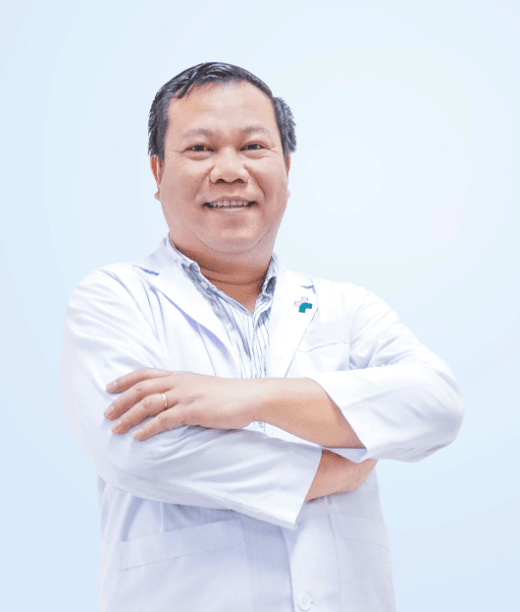
Specialist Level I Doctor Dang Duc Hoang
Dr. Dang Duc Hoang, MD, Specialist Level I – Head of the Department of General Surgery at Hoan My Dong Nai Hospital, has nearly 20 years of experience in urology and general surgery.
Position: Head of the Department of General Surgery at Hoan My Dong Nai Hospital
Languages: Vietnamese, English
1048A Pham Van Thuan, Bien Hoa Ward, Dong Nai, Dong Nai
Mon - Sat: 06:30-12:00, 13:00-16:30
Sun: 07:30-11:30
About Specialist Level I Doctor Dang Duc Hoang
Dr. Dang Duc Hoang, MD, Specialist Level I, is an outstanding specialist in general surgery and urology with nearly 20 years of intensive experience in surgical procedures and the treatment of surgical diseases. He holds a Specialist Level I degree in Urology and possesses advanced certifications in laparoscopic surgery, ranging from basic to advanced abdominal laparoscopy and advanced urological laparoscopy.
With superior professional competence combined with comprehensive hospital management skills, Dr. Dang Duc Hoang, MD, Specialist Level I, currently serves as the Head of the Department of General Surgery at Hoan My Dong Nai Hospital.
What conditions does Dr. Dang Duc Hoang, MD, Specialist Level I, treat?
Possessing high-level professional qualifications and mastery of modern laparoscopic surgical techniques, Dr. Dang Duc Hoang, MD, Specialist Level I, specializes in effective examination and treatment for the following groups of conditions:
- Examination, diagnosis, and performance of advanced urological laparoscopic surgery to treat renal calculi, ureteral calculi, vesical calculi, prostate adenomas, and urinary tract malformations.
- Application of advanced abdominal laparoscopic surgery to treat gastrointestinal and abdominal wall conditions such as appendicitis, gallstones, gallbladder polyps, inguinal hernia, and gastrointestinal tumors.
- Providing first aid, consultation, and performing complex emergency surgical procedures for abdominal trauma or urinary system trauma.
- Implementing and applying advanced, minimally invasive technical services to safely achieve curative therapy for intra-abdominal injuries.
- Providing professional advice on postoperative medication use and developing holistic care regimens, ensuring strict patient safety standards at the hospital.
Guidance on making appointments and the examination process with Dr. Dang Duc Hoang
- Step 1: Make an appointment via Bcare by calling the hotline or filling out the appointment form on the system to obtain a priority number, helping to manage time proactively and minimize waiting time upon arrival at the hospital.
- Step 2: Arrive at the reception desk of Hoan My Dong Nai Hospital to verify the scheduled appointment so that healthcare professionals can check information and guide you to receive a queue number for entry into the Specialty Clinic managed by the physician.
- Step 3: Enter the clinic to meet the physician directly for a clinical examination, discussing specific manifestations of pain, micturition disorders, or digestive issues, as well as your past medical history.
- Step 4: Proceed to functional rooms to undergo paraclinical tests as indicated by the physician, such as abdominal ultrasonography, urinary system ultrasound, radiography, computed tomography (CT), or urinalysis.
- Step 5: Bring the paraclinical results back to the initial clinic for the physician to review, analyze injury images, provide an accurate diagnostic conclusion, and advise on medical treatment or schedule appropriate laparoscopic surgery.
Notes before the examination
- Patients should bring all previous medical records, current prescriptions, and any laboratory results, ultrasound reports, or CT scans related to the abdomen or urinary tract from the last six months, if available.
- If there are signs of acute abdomen or suspicion that same-day laparoscopic surgery is required, patients should remain nil by mouth to ensure safety during the medical intervention.
- Patients seeking examination for urinary tract conditions should refrain from urinating before entering the clinic to facilitate bladder and prostate ultrasound surveys or more accurate urine specimen collection for testing.
Frequently Asked Questions
What benefits does urological laparoscopic surgery offer to patients with urolithiasis?
Advanced endoscopic techniques allow physicians to access and completely remove stones in the kidney, ureter, or urinary bladder through ultra-small incisions in the abdominal wall without the need for open surgery.
This method helps patients minimize postoperative pain, maximally reduce the risk of blood loss, decrease the incidence of surgical site infection, thereby shortening hospitalization time and facilitating rapid restoration of health.
What abnormal symptoms in the abdominal area indicate that a patient needs immediate general surgery evaluation?
Patients should seek immediate hospital evaluation if they exhibit signs such as severe abdominal pain or insidious prolonged pain of unknown etiology (especially right lower quadrant pain or epigastric region pain), abdominal distention, vomiting accompanied by fever, or hematochezia. These may be warning signs of dangerous emergency conditions such as appendicitis, cholecystitis, or intestinal obstruction.
What are the signs of urinary tract pathology requiring surgical intervention?
Typical signs include colic in the loin radiating to the groin, dysuria, urinary frequency, hematuria, intermittent urination, or weak urine flow. For accurate diagnosis, the physician will combine clinical examination with advanced radiology techniques such as urinary system ultrasound and Computed Tomography (CT) to precisely determine the location of stones, tumors, or obstructions before establishing a surgical regimen.
Professional strengths
Workplace
- •Hoan My Dong Nai Hospital
Experience
- •2014 – Present: Head of the Department of General Surgery, Hoan My Dong Nai Hospital
Education & training
- •Graduated with a Specialist Level I Degree in Urology
- •Certification in Advanced Urological Laparoscopy (2012)
- •Certification in Basic Abdominal Laparoscopic Surgery (2004)
- •Certification in Advanced Laparoscopic Surgery (2005)
- •Certification in State Management (2012)
- •Certification in Patient Safety (April 2016)
- •Certification in Hospital Management (May 2017)
- •Certification in Guiding the Implementation of Patient Safety Activities in Hospitals
- •Certification in Medication Counseling
- •Healthcare Mini-MBA Certification