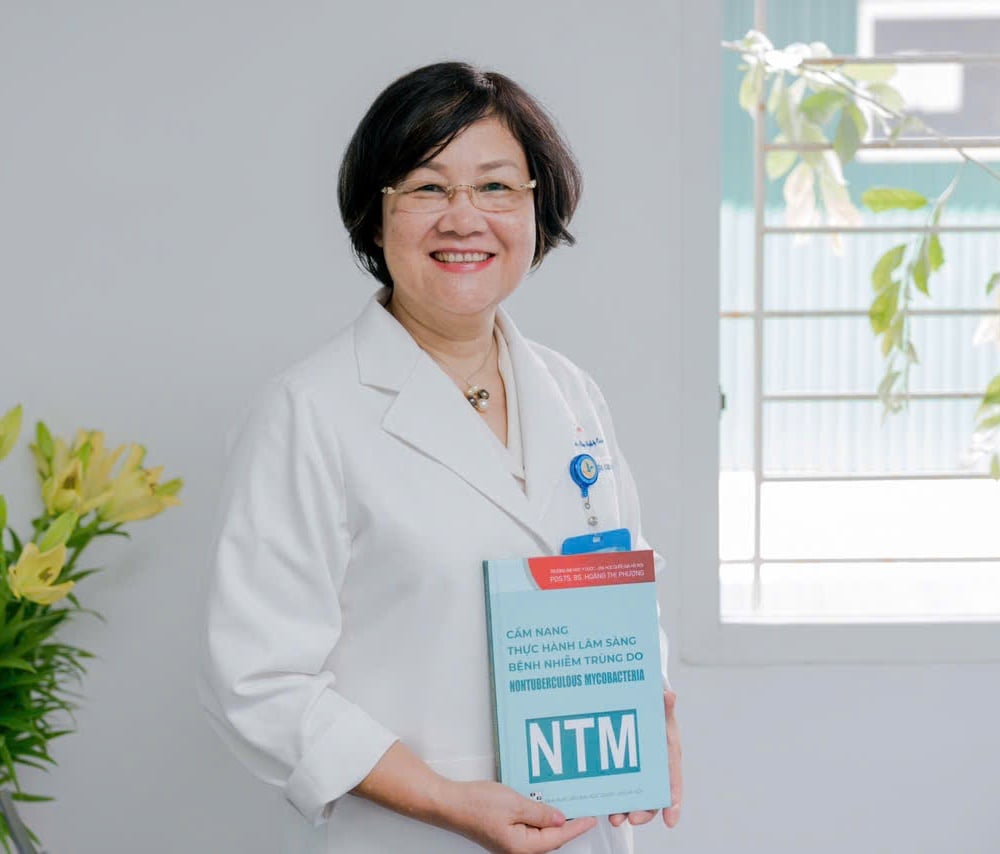
Assoc. Prof., PhD, MD Hoang Thi Phuong
Associate Professor, MD, PhD Hoang Thi Phuong, Former Head of the Department of Tuberculosis and Lung Diseases at the National Lung Hospital; Deputy Chair of the Department of Internal Medicine at VNU University of Medicine and Pharmacy, is a leading expert in the field of tuberculosis and respiratory diseases in Vietnam with nearly 40 years of experience.
Languages: Vietnamese, English
So 42, 44 Nghia Dung, Ba Dinh Ward, Hanoi, Hanoi
Thu - Fri: 07:00-12:00, 13:30-16:30
371.000đ
42 Nghia Dung, Ba Dinh Ward, Hanoi, Hanoi
Mon - Sun: 05:30-12:00, 12:00-21:00
About Assoc. Prof., PhD, MD Hoang Thi Phuong
Associate Professor, MD, PhD Hoang Thi Phuong is a leading expert in the field of tuberculosis and respiratory diseases in Vietnam, with a dedicated medical career spanning nearly 40 years. She previously held key leadership and core training positions, including Former Head of the Department of Tuberculosis and Lung Diseases at the National Lung Hospital, and Deputy Chair of the Department of Internal Medicine at the School of Medicine and Pharmacy - Vietnam National University, Hanoi.
With an excellent academic foundation comprising Master's and Doctoral degrees in Medicine from Hanoi Medical University, along with specialized certificates in infection control from Japan and research methodology from the US Centers for Disease Control and Prevention (CDC), she is recognized as a keen clinical physician who has authored numerous breakthrough studies that have saved many patients with life-threatening conditions.
Appointment Schedule Associate Professor, MD, PhD Hoang Thi Phuong
- Thursday - Friday: Morning: 7:30 AM - 12:00 PM; Afternoon: 1:30 PM - 5:00 PM
Dr. Hoang Thi Phuong's Experience in Treating Difficult Cases
Associate Professor, MD, PhD Hoang Thi Phuong possesses exceptional competence in diagnosing and treating complex and rare respiratory cases:
- Led research and successfully diagnosed the first rare case in Vietnam of disseminated Penicillium marneffei fungal infection in an HIV-negative patient.
- Directly detected and diagnosed a complex pathological condition recorded for the first time at the National Lung Hospital: Hemophagocytic Lymphohistiocytosis combined with AFB-positive pulmonary tuberculosis.
- Successfully researched and diagnosed an extremely rare case in Vietnam: Epithelioid hemangioendothelioma.
- Coordinated interdisciplinary emergency care to successfully treat a critical case of pulmonary tuberculosis complicated by severe respiratory failure, cardiopulmonary arrest, and multi-organ failure.
- Applied more than 22 scientific and technological products to clinical practice, establishing optimal treatment regimens for drug-resistant tuberculosis, disseminated tuberculosis, and dangerous chronic lung diseases.
Guide to Booking Appointments and Examination Procedures with Associate Professor, MD, PhD Hoang Thi Phuong
- Step 1: Book an appointment via Bcare by calling the hotline or filling out the booking information on the system to obtain a priority number, allowing you to proactively select a suitable time slot and minimize waiting time upon arrival.
- Step 2: Arrive at the facility's reception desk to verify your booked appointment so staff can check your information, complete initial administrative procedures, and issue a queue ticket for the Specialty Clinic.
- Step 3: Enter the examination room to meet the doctor directly for the initial clinical examination. The doctor will perform auscultation of the heart and lungs, check physical respiratory signs, and thoroughly elicit symptoms such as cough, dyspnea, fever, or tuberculosis epidemiological history.
- Step 4: Move to functional rooms to undergo advanced paraclinical tests as ordered by the doctor, including chest radiography, computed tomography (CT scan) of the thorax, spirometry, sputum examination for mycobacterium tuberculosis (AFB, GeneXpert), or blood tests to assess infection or fungal status.
- Step 5: Bring all test results back to the original examination room. Associate Professor Phuong will directly analyze lesions on imaging and biochemical indices, provide the most accurate diagnostic conclusion, prescribe medication, or advise on standard tuberculosis treatment regimens.
Notes Before Your Visit
- Patients should bring all previous medical records, discs containing prior chest X-rays or CT scans, along with current prescriptions, antibiotics, or medications for tuberculosis being taken at home, to allow the doctor to accurately assess lung lesion progression.
- If the patient is experiencing acute respiratory symptoms such as persistent cough, hemoptysis, or suspected tuberculosis, proactively wear a medical mask and immediately notify healthcare professionals at the reception desk to receive guidance on specialized triage, ensuring infection prevention safety.
- As the Associate Professor is currently involved in teaching and department management at Vietnam National University, Hanoi, and participating in scientific councils, her clinical schedule may change. Patients are advised to book appointments in advance via the Bcare system to confirm actual available slots.
Frequently Asked Questions
How can one recognize warning signs that a person is at risk for pulmonary tuberculosis and needs immediate medical attention?
The most characteristic symptom of pulmonary tuberculosis is a persistent cough lasting more than 2 weeks (dry cough, productive cough, or hemoptysis). Accompanying this, patients often exhibit systemic manifestations such as low-grade fever in the afternoon, night sweats, fatigue, anorexia, and rapid weight loss of unknown etiology. When these signs appear, patients should immediately visit pulmonology facilities for timely sputum testing and imaging.
Is pulmonary tuberculosis contagious, and what isolation precautions should be taken at home during the initial stage of treatment?
Pulmonary tuberculosis is transmitted via respiratory transmission when patients cough, sneeze, or spit, dispersing bacteria into the air. During the first 2 to 4 weeks of starting antituberculosis pharmacotherapy, patients should limit close contact with family members, wear a medical mask when communicating, sleep in a well-ventilated private room without closed air conditioning, and expectorate sputum into tissues which must then be properly disposed of to prevent community transmission.
Why is adherence to tuberculosis treatment principles extremely strict, and what are the complications of discontinuing medication?
Tuberculosis treatment requires strict adherence to principles: correct regimen, adequate dosage, daily regularity, and sufficient duration (typically extending from 6 to 8 months). If patients voluntarily reduce dosage, take medication intermittently, or discontinue treatment midway when symptoms remit, the mycobacterium will rapidly mutate, leading to drug-resistant or extensively drug-resistant tuberculosis. At this point, treatment becomes extremely difficult, costly, prolonged, and associated with increased mortality.
Workplace
- •Medlatec General Hospital
Experience
- •October 1989 - September 2003: Attending Physician, National Lung Hospital.
- •September 2003 - May 2007: Deputy Head of the Department of Tuberculosis and Lung Diseases, National Lung Hospital.
- •May 2007 - 2016: Head of the Department of Tuberculosis and Lung Diseases, National Lung Hospital.
- •2016 - Present: Lecturer in the Department of Internal Medicine, concurrently serving in the Interdisciplinary Department - Faculty of Medicine and Pharmacy - Vietnam National University, Hanoi.
Awards & recognition
- •2009: Certificate of Merit for outstanding achievements in the emulation movement for creative labor and scientific-technical innovation, Hanoi City Federation of Labor.
- •2014: Special Commendation: For achievements in researching and diagnosing the first rare case in Vietnam of disseminated Penicillium marneffei fungal infection in an HIV-negative patient, awarded by the Director of the National Lung Hospital.
- •2016: Special Commendation: For achievements in researching and diagnosing the first rare case at the National Lung Hospital: Hemophagocytic Lymphohistiocytosis / AFB-positive pulmonary tuberculosis, awarded by the Director of the National Lung Hospital.
- •2016: Special Commendation: For achievements in researching and diagnosing the first rare case in Vietnam: Epithelioid hemangioendothelioma, awarded by the Director of the National Lung Hospital.
- •2016: Letter of Commendation for outstanding achievements in coordinating successful emergency resuscitation of a "case of pulmonary tuberculosis complicated by respiratory failure, cardiopulmonary arrest, and multi-organ failure" at the Intensive Care Center, Bach Mai Hospital.
Education & training
- •1980 - 1986: General Practitioner in Internal Medicine and Pediatrics, Hanoi Medical University.
- •1999: Master of Medicine, Hanoi Medical University.
- •2010: Doctor of Medicine (PhD), Hanoi Medical University.
- •2007: Course on research methods conducted by the US Centers for Disease Control and Prevention (CDC - USA) and the National Lung Hospital.
- •2003: Cardiology Orientation Specialty, National Heart Institute.
- •2015: Training Course on Tuberculosis and Infectious Disease Control, Japanese National Institute of Infectious Diseases (Tuberculosis Research Institute).
- •2008: State Management: Specialist at the Ministry of Health, National Academy of Public Administration.
- •2009: Two-year part-time French proficiency program, Hanoi University of Languages and International Studies.