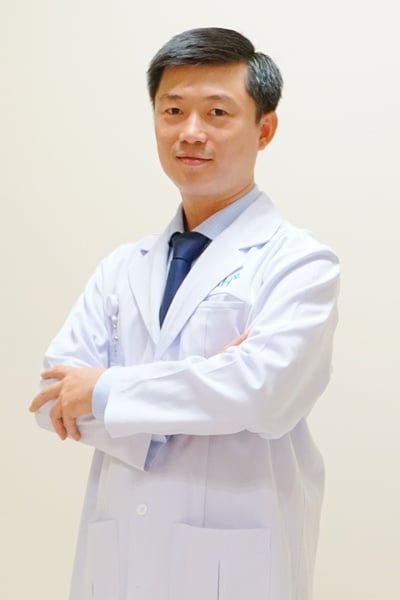
Specialist Level II Doctor Lê Trong Nghia
MD, Specialist Level II Lê Trong Nghia has more than 21 years of experience in the diagnosis and surgical treatment of cranial, spinal, and peripheral nerve compression disorders. Currently, MD, Specialist Level II Lê Trong Nghia serves as Deputy Head of Department of Neurosurgery, Spine, and Skull Surgery at Nam Saigon International General Hospital.
Position: Deputy Head of Department – Neurosurgery, Spine, and Skull Surgery
Languages: Vietnamese, English
So 88, Duong so 8, Khu dan cu Trung Son, Binh Hung Commune, Ho Chi Minh City, Ho Chi Minh City
Mon - Sat: 07:00-12:00, 13:30-17:00
300.000đ
About Specialist Level II Doctor Lê Trong Nghia
MD, Specialist Level II Lê Trong Nghia is a reputable expert in the field of Neurosurgery, Spine, and Skull Surgery with over 21 years of experience in diagnosing and surgically treating cranial, spinal, and peripheral nerve compression conditions. Having worked for 18 years at major hospitals such as Gia Dinh General Hospital and City International Hospital (CIH), the physician has exceptional strengths in microsurgery combined with endoscopy for microvascular decompression to treat trigeminal neuralgia and hemifacial spasm, peripheral nerve decompression surgery, as well as advanced pain intervention methods such as Gasserian ganglion thermocoagulation, facet joint blocks, and vertebral body cement augmentation.
For outstanding contributions to clinical care and medical research, the physician has received numerous certificates of merit from the Ho Chi Minh City People's Committee and the Ho Chi Minh City Department of Health, and was awarded the "Golden Hands" title. Currently, MD, Specialist Level II Lê Trong Nghia holds the position of Deputy Head of Department of Neurosurgery, Spine, and Skull Surgery at Nam Saigon International General Hospital.
Treatment Experience of MD, Specialist Level II Lê Trong Nghia
With more than 21 years of clinical experience and extensive scientific research in neurosurgery, MD, Specialist Level II Lê Trong Nghia has successfully performed many complex surgical procedures:
- Cranial, spinal, and peripheral nerve disorders
- Brain and spinal cord tumors
- Cerebral aneurysms and vascular malformations
- Brain and spinal injuries
- Stroke and spinal degeneration issues
- Emergency surgery for traumatic brain injury
- Surgery for thoracolumbar spine trauma
- Surgery for ventriculomegaly
- Surgery for cerebral aneurysm sacs and cerebral vascular malformations
- Surgery for brain tumor
- Microvascular decompression surgery for trigeminal neuralgia and facial spasm
Guide to Making an Appointment and Examination Process with MD, Specialist Level II Lê Trong Nghia
- Step 1: Make an appointment via Bcare by calling the hotline or filling out the appointment information on the system to obtain a priority number, helping to reduce waiting time and proactively manage examination time.
- Step 2: Go to the reception desk of Nam Saigon International General Hospital, verify the scheduled appointment information so that healthcare professionals can guide you through completing the procedures and admit you to the clinic within the Department of Neurosurgery, Spine, and Skull Surgery.
- Step 3: Enter the clinic to meet MD, Specialist Level II Lê Trong Nghia for a clinical examination, assessment of neurological reflexes, evaluation of motor function and sensation, and detailed elicitation of disease symptoms.
- Step 4: Undergo specialized paraclinical tests such as Magnetic Resonance Imaging (MRI) of the cranium/spine, computed tomography (CT scanner), X-ray, or electromyography according to the physician's professional advice.
- Step 5: Return to the clinic for the physician to interpret results, conclude the status of nerve compression or cranial/spinal injury, and advise on an appropriate medical treatment regimen, pain intervention, or surgical indication.
Notes Before the Examination
- Bring your complete patient health booklet, current prescription, and any previous MRI, CT scanner, or X-ray films if available.
- Record details regarding the occurrence frequency of pain episodes, pain location (such as unilateral facial pain, pain radiating to the limbs), or muscle spasms to discuss with the physician.
- Notify the physician if you are taking anticoagulants or undergoing treatment for concomitant chronic diseases.
- Prepare questions regarding your condition or surgical methods for the physician to answer directly.
- Arrive 10 to 15 minutes before the scheduled time to complete confirmation procedures at the reception desk.
Frequently Asked Questions
What are the recognizable manifestations of trigeminal neuralgia, and what effectiveness does microvascular decompression offer?
Trigeminal neuralgia typically manifests as severe, electric shock-like or stabbing pains on one side of the face, appearing suddenly during talking, chewing food, washing the face, or slight touch to the facial region. Microvascular decompression is a surgical intervention aimed at separating the compressing blood vessel from the trigeminal nerve. Consequently, this method helps eliminate the root cause of pain, supports patients in reducing prolonged pain episodes, and significantly improves quality of life.
What causes hemifacial spasm, and how is it treated?
Hemifacial spasm usually arises from vascular compression of the facial nerve (cranial nerve VII) at its exit point from the brainstem, causing spontaneous, uncontrollable contractions of the muscles on one side of the face. Initially, spasms often appear mildly in the eyelid muscles, then gradually spread to the buccal region, mouth, and neck. The physician may indicate microsurgical microvascular decompression (possibly assisted by endoscopy) to release the nerve compression, help control spasms, and restore natural facial muscle function.
For which pathological conditions is vertebral body cement augmentation indicated?
Vertebral body cement augmentation is a minimally invasive procedure indicated for patients with vertebral collapse due to osteoporosis or vertebral body tumor lesions causing severe pain and limited range of motion. The physician injects bone cement into the collapsed vertebral body under fluoroscopic guidance to reinforce and stabilize the vertebral structure. This method supports rapid pain relief, enables early mobilization and ambulation after intervention, and shortens hospitalization.
Workplace
- •Nam Saigon International General Hospital
Experience
- •2005 – 2019: Attending Physician in the Department of Neurosurgery, Gia Dinh General Hospital.
- •2019 – 2023: Physician in Charge of Neurosurgery Specialties, City International Hospital (CIH).
- •2023 – Present: Deputy Head of Department of Neurosurgery, Spine, and Skull Surgery, Nam Saigon International General Hospital.
Awards & recognition
- •Awarded the title of Grassroots Emulation Fighter by the Ho Chi Minh City Department of Health in 2011, 2012, 2015, 2016, and 2018.
- •Commended by the Ho Chi Minh City Healthcare Industry Trade Union for excellent achievements in the "Golden Hands" movement in 2015 and 2016.
- •Certificate of Merit from the Ho Chi Minh City People's Committee for excellently completing tasks for two consecutive years, 2015–2016.
Education & training
- •1998 – 2004: General Practitioner, University of Medicine and Pharmacy at Ho Chi Minh City.
- •March 2006 – September 2006: Preliminary Specialty Training in Neurosurgery, Cho Ray Hospital.
- •2008 – 2010: Specialist Level I in Neurosurgery, University of Medicine and Pharmacy at Ho Chi Minh City.
- •2016 – 2018: Specialist Level II in Neurosurgery, University of Medicine and Pharmacy at Ho Chi Minh City.