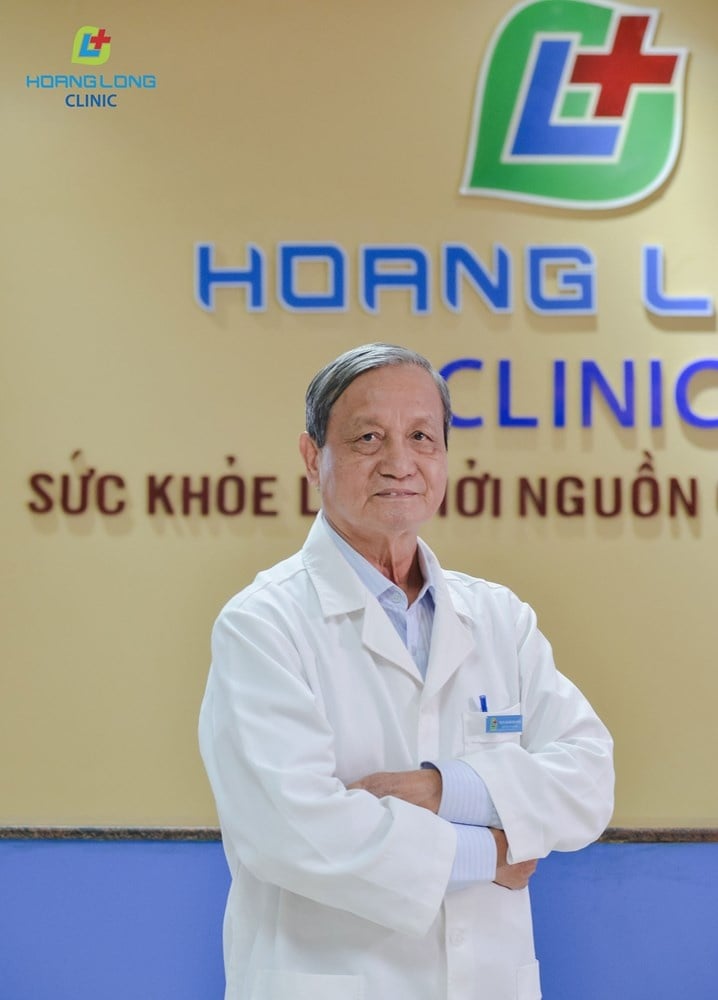
Assoc. Prof., PhD, MD Nghiem Dinh Phan
Associate Professor, MD, PhD Nghiem Dinh Phan is a leading expert in the field of Gastrointestinal, Hepatobiliary, and Pancreatic Surgery with more than 40 years of experience in clinical practice. The physician currently serves as Medical Director at Hoang Long General Clinic.
Position: Medical Director - Hoang Long General Clinic
Languages: Vietnamese, English
Tang 10, Toa VCCI, So 9 Dao Duy Anh, Dong Da Ward, Hanoi, Hanoi
Mon - Sat: 07:00-12:00, 13:00-17:00
About Assoc. Prof., PhD, MD Nghiem Dinh Phan
Associate Professor, MD, PhD Nghiem Dinh Phan is a leading expert in the field of Gastrointestinal, Hepatobiliary, and Pancreatic Surgery in Vietnam with more than 40 years of experience in clinical practice, teaching, and health administration. Before assuming the position of Medical Director at Hoang Long General Clinic, the Associate Professor dedicated 14 years of outstanding service as Head of the Department of Surgery at the Military Medical Academy - Hospital 103, training multiple generations of surgeons for the country.
In recognition of his significant contributions, the physician was honorably awarded the Order of National Defense and the War Merit Medal by the State. Currently, the physician serves as the ultimate professional reference, specializing in consultations and guiding surgical interventions for complex gastrointestinal, hepatobiliary, and pancreatic cases.
Key Professional Strengths of Associate Professor, MD, PhD Nghiem Dinh Phan
- Advisory and Guidance on Surgical Intervention: Conducting examinations, performing in-depth consultations, and providing accurate surgical indications for diseases requiring gastrointestinal surgical intervention, such as gastric and colorectal tumors/cancer, large polyps that cannot be managed via standard endoscopy, gallstones, cholangitis, and congenital malformations of the gastrointestinal tract.
- Comprehensive Management of Anorectal Diseases: Establishing treatment regimens and directly guiding modern, minimally invasive interventional methods for patients with severe internal/external hemorrhoids, anal fistula, anal fissure, or rectal prolapse.
- Management and Enhancement of Medical Quality: In his capacity as Medical Director, the Associate Professor directly supervises and optimizes surgical examination and therapeutic endoscopy procedures at Hoang Long General Clinic, ensuring safety, accuracy, and alignment with international medical standards.
Guide to Booking Appointments and Examination Procedures with Associate Professor, MD, PhD Nghiem Dinh Phan
- Step 1: Book an appointment through the Bcare system by calling the hotline or registering online to receive a priority queue number. As the Associate Professor holds the role of Medical Director with a busy schedule involving management, consultations, and regimen approvals, patients should book in advance to ensure a suitable appointment slot is arranged.
- Step 2: Arrive at the reception desk of Hoang Long General Clinic according to the scheduled appointment time. Healthcare professionals will assist in verifying pre-booked information, completing detailed administrative medical records, and directing patients to the Associate Professor's private examination room.
- Step 3: Enter the examination room to meet Associate Professor Nghiem Dinh Phan directly. With the exemplary professional conduct of a military physician, the doctor will perform a clinical examination (palpation, visual inspection of the abdomen/anorectal region), thoroughly explore symptom progression, and review previous imaging studies or internal medicine treatment records.
- Step 4: Move to functional rooms to undergo necessary paraclinical tests. Depending on the suspicious lesion, you may be ordered imaging such as abdominal computed tomography (CT-Scanner), high-tech abdominal ultrasonography, gastrointestinal therapeutic endoscopy, or specialized blood tests to assess coagulation function and cancer screening markers.
- Step 5: Return to the examination room with all results. The Associate Professor will directly analyze structural damage images from scans or endoscopy recordings, provide an accurate diagnostic conclusion: whether the disease can continue with medical treatment (medication) or must proceed to surgical intervention (surgery), thereby advising the best course of action for the patient.
Important Notes for Patients
- Fasting Preparation for Examinations: Patients should strictly fast for 6-8 hours before the visit to be prepared for any same-day orders for ultrasound, blood tests, or gastrointestinal endoscopy.
- Preparation of Previous Records: Gastrointestinal surgical diseases require absolute accuracy in radiology diagnosis. You are required to bring CT scans, MRI results, endoscopy reports, and old prescriptions from other hospitals (if available) for the Associate Professor to reference and provide the most accurate conclusions.
Frequently Asked Questions
When does a gastrointestinal polyp (stomach/colon) require surgical intervention instead of standard endoscopic resection?
Most small or moderate-sized gastrointestinal polyps can be safely removed during flexible colonoscopy/gastroscopy. However, patients will be indicated for surgical intervention (surgery) when:
- The polyp is excessively large (exceeding the safe resection capability via endoscopy);
- The polyp has a broad base, deeply invading the muscular layer of the intestinal wall;
- The polyp lesion shows signs of malignant transformation with deep invasion into the submucosa;
- The polyp structure is located in difficult-to-reach angles, where attempting endoscopic resection poses a risk of bowel perforation or uncontrollable massive bleeding.
At what stage of hemorrhoid disease is surgery indicated, and what advanced, less painful surgical methods are currently available?
Surgical indication for hemorrhoids is typically applied to internal hemorrhoids grade 3 or higher (hemorrhoidal masses prolapsing during defecation, requiring manual reduction or completely prolapsed and irreducible), complicated hemorrhoids with thromboembolic complications, strangulated prolapse, or prolonged hemorrhage causing severe anemia.
Currently, medicine offers advanced, minimally invasive, and maximally pain-reducing surgical methods for patients, such as Stapled Hemorrhoidopexy (Longo procedure, using an automatic stapler to excise and suspend the hemorrhoidal mass high up, cutting off its blood supply, performed in the insensate zone of the rectum resulting in minimal pain and rapid recovery) or Doppler-guided hemorrhoidal artery ligation (THD).
Why does early detection of premalignant lesions in the colorectum determine the patient's survival prognosis?
Colorectal cancer largely progresses insidiously from initially benign polyps over 5 to 10 years without causing any painful symptoms in the early stages. If patients proactively seek screening and detect the disease at the premalignant lesion stage or very early-stage cancer (Stage 0 or 1), physicians can intervene to enucleate the entire lesion radically, potentially achieving a 5-year survival rate of over 90%. Conversely, if the disease progresses to late stage, with deep tumor invasion and metastasis to other organs, surgery becomes extremely complex and costly, and the survival prognosis deteriorates seriously.
Professional strengths
Workplace
- •Hoang Long General Clinic
Experience
- •Head of the Department of Surgery, Military Medical Academy Hospital 103 (2000 - 2014);
- •Member of the Vietnam Society of Surgery;
- •Member of the Disaster Prevention Committee - under the Ministry of Health;
- •Currently serving as Medical Director - Hoang Long General Clinic
Awards & recognition
- •Order of National Defense;
- •War Merit Medal.