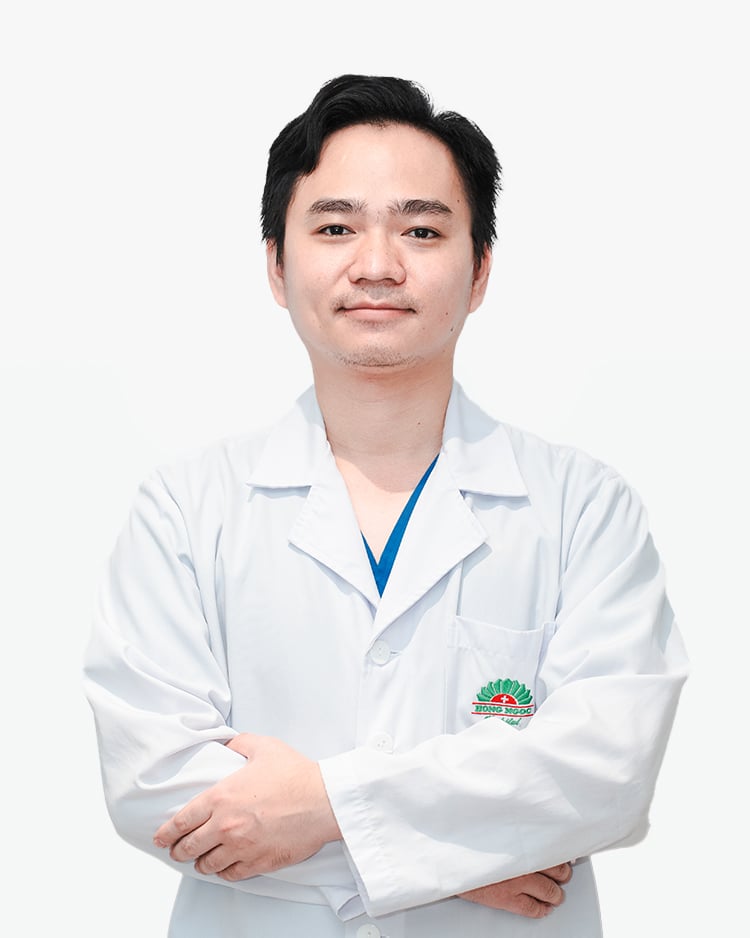
MSc, MD Nguyen Dinh Cong
MD, MSc. Nguyen Dinh Cong - Deputy Head of the Department of Cardiology at Hong Ngoc Phuc Truong Minh Hospital, is a young and dynamic specialist in the field of Cardiology and Interventional Cardiology with more than 10 years of clinical experience.
Position: Deputy Head of the Department of Cardiology - Hong Ngoc Phuc Truong Minh General Hospital
Languages: Vietnamese, English
So 8 duong Chau Van Liem, Tu Liem Ward, Hanoi, Hanoi
Mon - Sun: 07:30-12:00, 13:30-17:00
About MSc, MD Nguyen Dinh Cong
MD, MSc. Nguyen Dinh Cong is a young, dynamic, and confident specialist in the field of Cardiology and Interventional Cardiology with more than 10 years of clinical experience. The physician possesses a solid, systematic educational foundation, having graduated as a General Practitioner (MD) and obtained a Master’s degree in Internal Medicine from Hanoi Medical University. To master modern techniques for treating coronary artery disease, the physician completed specialized training programs and received certification in Interventional Cardiology at Bach Mai Hospital - Campus 1 - Hanoi, along with certification in Echocardiography at Hanoi Heart Hospital.
Before being trusted with the appointment to the position of Deputy Head of the Department of Cardiology at Hong Ngoc - Phuc Truong Minh General Hospital in 2025, the physician had a long period of stable service working as an Interventional Cardiologist at Thanh Nhan Hospital.
Which cases is Dr. Nguyen Dinh Cong professionally responsible for?
MD, MSc. Nguyen Dinh Cong directly performs examinations, carries out interventional procedures, and develops monitoring regimens for the following conditions:
- Coronary Artery Disease: Examination, diagnosis, and direct performance of basic cardiovascular interventional techniques (such as angioplasty and stent placement) to resolve coronary stenosis or occlusion causing myocardial ischemia.
- Management of Chronic Cardiovascular Diseases: Establishing optimal medical treatment pathways for patients with hypertension, heart failure, cardiomyopathy, dyslipidemia, or cardiac arrhythmias ranging from basic to complex.
- Diagnostic Imaging and Cardiac Functional Exploration: Directly performing and analyzing results of basic echocardiography to accurately assess cardiac structure, systolic function, and valve activity.
- Cardiovascular Emergency and Intervention: Receiving and managing cardiovascular emergency conditions such as acute myocardial infarction, malignant hypertensive crisis, or acute heart failure.
Guide to Booking Appointments and the Examination Process with Dr. Nguyen Dinh Cong
- Step 1: Book an examination appointment via the Bcare system by calling the hotline or filling out online registration information to receive a priority queue number and proactively select a time slot suitable for your personal schedule.
- Step 2: Arrive at the reception desk of Hong Ngoc - Phuc Truong Minh General Hospital at the scheduled time so that healthcare professionals can quickly complete the information verification procedures.
- Step 3: Proceed to the Cardiology Specialty Clinic where Dr. Nguyen Dinh Cong will directly perform a clinical examination, auscultate the heart and lungs, check peripheral pulses, and assess initial cardiovascular signs.
- Step 4: Undergo paraclinical tests as ordered by the physician, including: electrocardiogram (ECG), basic echocardiography, chest X-ray, or blood tests to evaluate cardiac enzymes, lipid profile, and coagulation function.
- Step 5: Return to the original consultation room to hear the physician analyze the results, make a definitive diagnosis, receive a medical treatment regimen or advice on percutaneous coronary intervention if indicated, and get a follow-up appointment.
Notes before the visit:
- Patients need to bring all previous medical records, imaging films, old ECGs, echocardiograms, and especially their current daily prescriptions so the physician can assess medication tolerance.
- For blood tests checking the lipid profile or metabolic function, patients should strictly observe complete fasting for at least 6 to 8 hours before sample collection.
- Patients taking cardiovascular medications (especially antihypertensives and anticoagulants) should continue taking their medication as usual and not discontinue it voluntarily unless specifically instructed by the physician.
- Choose comfortable clothing, preferably a shirt with front buttons, to facilitate exposure of the chest area during ECG recording or echocardiography.
- Proactively arrive approximately 10 to 15 minutes earlier than the scheduled appointment time to ensure the reception process and initial screening blood pressure measurement proceed smoothly.
Frequently Asked Questions
How is interventional cardiology performed for coronary artery disease, and is it safe?
Interventional cardiology is an advanced, minimally invasive treatment method for patients with narrowed or blocked coronary arteries. Instead of requiring open-chest surgery like traditional surgical procedures, the physician threads a small catheter through a blood vessel in the wrist or thigh to reach the heart.
Under fluoroscopic guidance, the physician accesses the site of the stenotic blood vessel, performs ballooning, and places a small metal mesh scaffold (stent) to release the vascular lumen, helping restore normal blood circulation to nourish the myocardium. This technique has a high safety profile, quick execution time, very small wounds, and helps patients achieve rapid recuperation after the intervention.
When should a patient with chest pain suspect the risk of coronary artery disease?
Typical angina pectoris caused by coronary artery disease often feels like compression, strangulation, or tightness in the chest, usually located retrosternally or deviating to the left side of the chest. This pain tends to radiate to the shoulder, jaw, or along the medial surface of the left arm. A key characteristic is that the pain typically appears during exertion (walking fast, climbing stairs, strong emotional stress) and diminishes with rest or sublingual vasodilators. If the pain occurs suddenly even at rest and lasts longer than 15–20 minutes, it may be a sign of acute myocardial infarction requiring immediate emergency transport.
What abnormalities of the cardiovascular system can periodic basic echocardiography help detect?
Basic echocardiography is a safe, painless, and non-toxic diagnostic imaging technique that uses ultrasound waves to reconstruct dynamic images of the heart. Through the echocardiographic results, the physician can perform a comprehensive assessment of the dimensions of the cardiac chambers and accurately measure the ejection fraction (the heart's pumping capacity) to detect heart failure.
At the same time, this technique helps detect valvular heart diseases (stenosis, valve regurgitation), myocardial injury, pericardial effusion, as well as congenital heart defects if present, thereby strongly supporting the timely establishment of medical treatment or interventional regimens.
Professional strengths
Workplace
- •Hong Ngoc Phuc Truong Minh General Hospital
Experience
- •2015 - 10/2023: Interventional Cardiologist at Thanh Nhan Hospital
- •10/2023 - Present: Interventional Cardiologist at Hong Ngoc - Phuc Truong Minh General Hospital
- •Year 2025: The physician was appointed as Deputy Head of the Department of Cardiology - Interventional Cardiology at Hong Ngoc - Phuc Truong Minh General Hospital
Education & training
- •2015 - 10/2023: Interventional Cardiologist at Thanh Nhan Hospital
- •10/2023 - Present: Interventional Cardiologist at Hong Ngoc - Phuc Truong Minh General Hospital
- •Year 2025: The physician was appointed as Deputy Head of the Department of Cardiology - Interventional Cardiology at Hong Ngoc - Phuc Truong Minh General Hospital