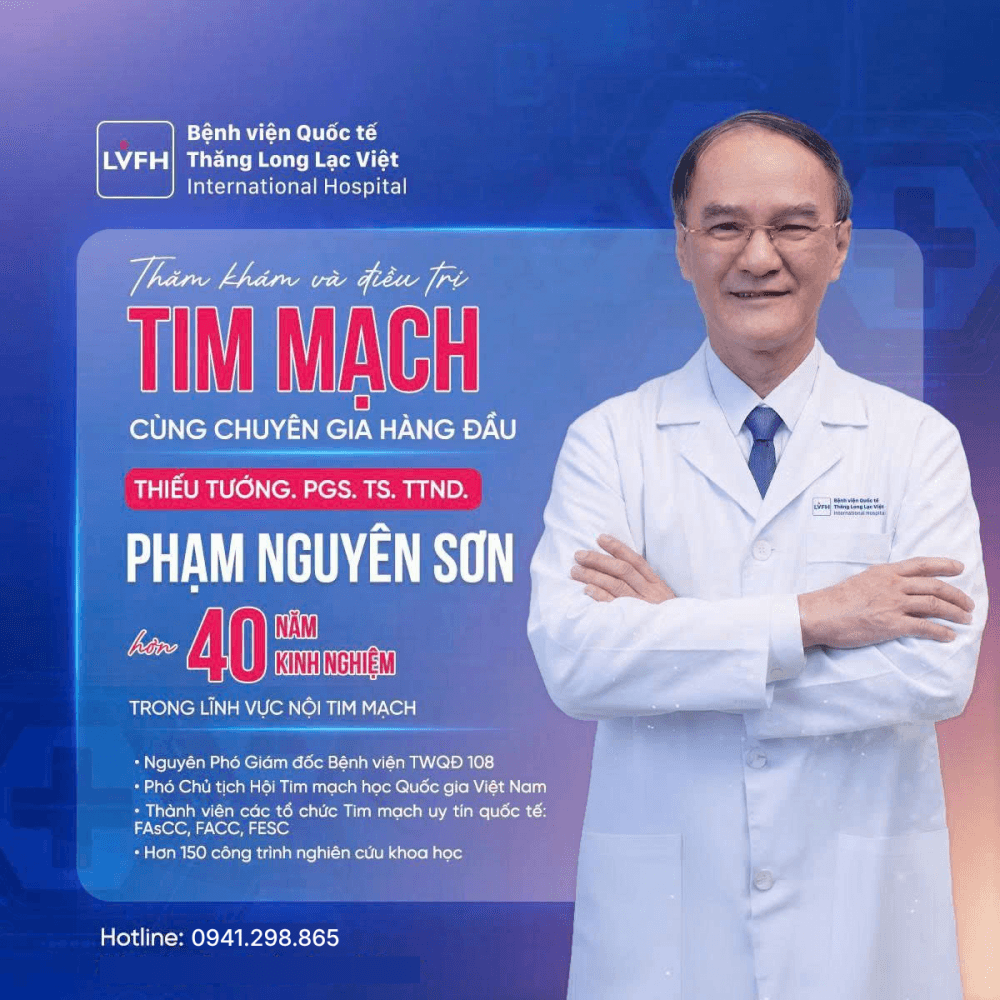
Assoc. Prof., PhD, MD Pham Nguyen Son
Associate Professor, MD, PhD, Senior Specialist Physician Pham Nguyen Son is a leading expert in interventional cardiology in Vietnam with over 40 years of experience. He holds the military rank of Major General and is the former Deputy Director of the 108 Central Military Hospital and the former Vice Director of the Institute of Cardiology (108 CMH).
Position: Former Deputy Director; Former Vice Director of the Institute of Cardiology - 108 Central Military Hospital
Languages: Vietnamese, English
So 9 Phan Chu Trinh, Cua Nam Ward, Hanoi, Hanoi
Tue, Thu: 07:15-11:45, 13:15-16:45
Toa nha so 154 Nguyen Thai Hoc, Ba Dinh Ward, Hanoi, Hanoi
Mon - Sat: 08:00-12:00, 13:30-17:00
About Assoc. Prof., PhD, MD Pham Nguyen Son
Associate Professor, MD, PhD, Senior Specialist Physician Pham Nguyen Son is a leading expert and a distinguished People's Physician in the field of cardiology in Vietnam with more than 40 years of clinical examination and treatment experience. The Associate Professor has held many particularly important positions at top-tier healthcare facilities, such as Former Deputy Director of the 108 Central Military Hospital, Former Vice Director of the Institute of Cardiology, and concurrently Former Head of the Department of Cardiovascular Internal Medicine at the 108 Central Military Hospital.
The physician received advanced international training in countries with developed medical systems, such as France, Canada, and Malaysia. He is currently the Vice President of the National Heart Association of Vietnam and a prestigious Fellow of the American College of Cardiology (FACC), the European Society of Cardiology (FESC), and the ASEAN Federation of Cardiology (FAsCC).
Clinic schedule for Associate Professor, MD, PhD Pham Nguyen Son at Thang Long Lac Viet International Hospital
Associate Professor, MD, PhD Pham Nguyen Son has a cardiovascular clinic schedule at Thang Long Lac Viet International Hospital on Tuesdays and Thursdays each week.
- Summer hours (From April 16 to October 15): Morning (07:15 - 11:45), Afternoon (13:30 - 17:00).
- Winter hours (From October 16 to April 15): Morning (07:30 - 12:00), Afternoon (13:30 - 17:00).
What conditions does Dr. Pham Nguyen Son treat?
- Examination, in-depth consultation, and establishment of comprehensive treatment regimens for cardiovascular system diseases, including: heart failure, hypertension, coronary artery disease, cardiac arrhythmia, valvular heart disease, peripheral vascular disease, and congenital heart disease...
- Examination and management of metabolic and endocrine disorders, such as: lipid metabolism disorder (high blood lipids), diabetes mellitus, and thyroid-related diseases.
- Multidisciplinary combination therapy for dangerous chronic respiratory diseases, such as chronic obstructive pulmonary disease (COPD), bronchial diseases, and pulmonary disorders.
- Comprehensive examination and treatment of gastrointestinal diseases, including stomach, colon, hepatobiliary diseases, and common musculoskeletal conditions such as gout and osteoarthritis.
- Management of complications, rehabilitation, and treatment of neurological conditions following stroke or injuries to the peripheral nervous system.
Guidance on booking appointments and the examination process with Dr. Pham Nguyen Son
- Step 1: Make an appointment via Bcare by calling the hotline or filling out the appointment information on the system to obtain a priority number, allowing you to manage your time proactively and avoid long waits upon arrival at the hospital.
- Step 2: Arrive at the hospital reception desk to verify the scheduled appointment so that healthcare professionals can check the information, complete the initial administrative medical record, and issue a referral slip to the clinic room.
- Step 3: Enter the clinic room for the physician to perform a direct clinical examination, listen to uncomfortable symptoms, take the past medical history and medication history, or review previous laboratory results brought from other facilities.
- Step 4: Move to functional rooms to undergo necessary paraclinical tests, such as electrocardiogram, echocardiography, chest radiograph, blood tests for micronutrient screening, or other specialized functional exploration methods depending on the patient's condition.
- Step 5: Return to the original clinic room for the physician to read the paraclinical results, analyze the extent of damage, provide the final diagnosis, prescribe medication, or advise on an appropriate intervention regimen.
Notes before the visit
- Patients need to bring all previous medical records, X-ray films, computed tomography scans, ECG recordings, and all current prescriptions used at home so that the physician has the most comprehensive data for comparison.
- For cases likely to require same-day blood tests to check glycemic index, lipid profile, or liver and kidney function, patients should proactively fast for 6 to 8 hours before the examination.
Frequently Asked Questions
Can heart failure be cured completely, and what are the signs that this condition is progressing severely?
Heart failure is a progressive chronic disease that cannot be completely cured but can be well controlled, extending life span and improving quality of life if the medical treatment regimen is optimized early. Patients need to recognize signs of advanced heart failure to seek immediate medical attention, including: progressive dyspnea (especially when lying supine or during mild exercise), persistent dry cough at night, bipedal edema (particularly in the ankle region and dorsum of foot), and continuous fatigue and shortness of breath.
How does chronic obstructive pulmonary disease (COPD) affect the cardiovascular system, and how can complications be prevented?
Chronic obstructive pulmonary disease (COPD) causes chronic hypoxia in the blood, increasing pressure on the pulmonary vasculature, which over time leads to chronic cor pulmonale (right-sided heart failure due to lung disease). To prevent this dangerous cardiovascular complication, COPD patients must strictly adhere to their bronchodilator regimen, receive periodic influenza vaccination and pneumococcal vaccination, absolutely abstain from tobacco use, and coordinate periodic cardiovascular function screening with a specialist physician.
Why do patients with diabetes mellitus and lipid metabolism disorder need periodic cardiovascular screening?
Diabetes mellitus and lipid metabolism disorder are leading risk factors causing insidious vascular lumen injury, accelerating the formation of atheromas, and leading to stenosis or occlusion of great arteries. This condition increases the risk of experiencing dangerous cardiovascular events such as myocardial infarction, coronary artery disease, or stroke. Periodic cardiovascular screening helps physicians achieve early detection of vascular lesions in the latent phase for protective treatment, preventing adverse events for the patient.
Professional strengths
Workplace
- •Thang Long Lac Viet International Hospital
Experience
- •Former Hospital Deputy Director of the 108 Central Military Hospital
- •Former Vice Director of the Institute of Cardiology - 108 Central Military Hospital
- •Former Head of the Department of Cardiovascular Internal Medicine - 108 Central Military Hospital
- •Former Head of the Department of Cardiovascular Internal Medicine - 108 Institute for Clinical Medical and Pharmaceutical Research
- •Vice President of the National Heart Association of Vietnam
- •Vice President of the Vietnam Heart Failure Society
- •Former Member of the Military Medical Science Council – Ministry of National Defense
- •Member of the Northern Professional Panel – Central Committee for Cadre Health Care and Protection
- •Fellow of the ASEAN Federation of Cardiology (FAsCC)
- •Fellow of the American College of Cardiology (FACC)
- •Fellow of the European Society of Cardiology (FESC)
Education & training
- •Participated in a cardiology specialty training course at the National Heart Institute of Malaysia (2006)
- •Participated in a cardiology specialty training course at Laveran Hospital and La Timone Hospital – Marseille - French Republic (2003)
- •PhD in Cardiology (2002)
- •Participated in a cardiology specialty training course at Sherbrooke University Faculty of Medicine – Québec – Canada (1994-1995)
- •Resident physician in Internal Medicine at the Military Medical Academy. MD, Specialist Level I in Internal Medicine (1986)