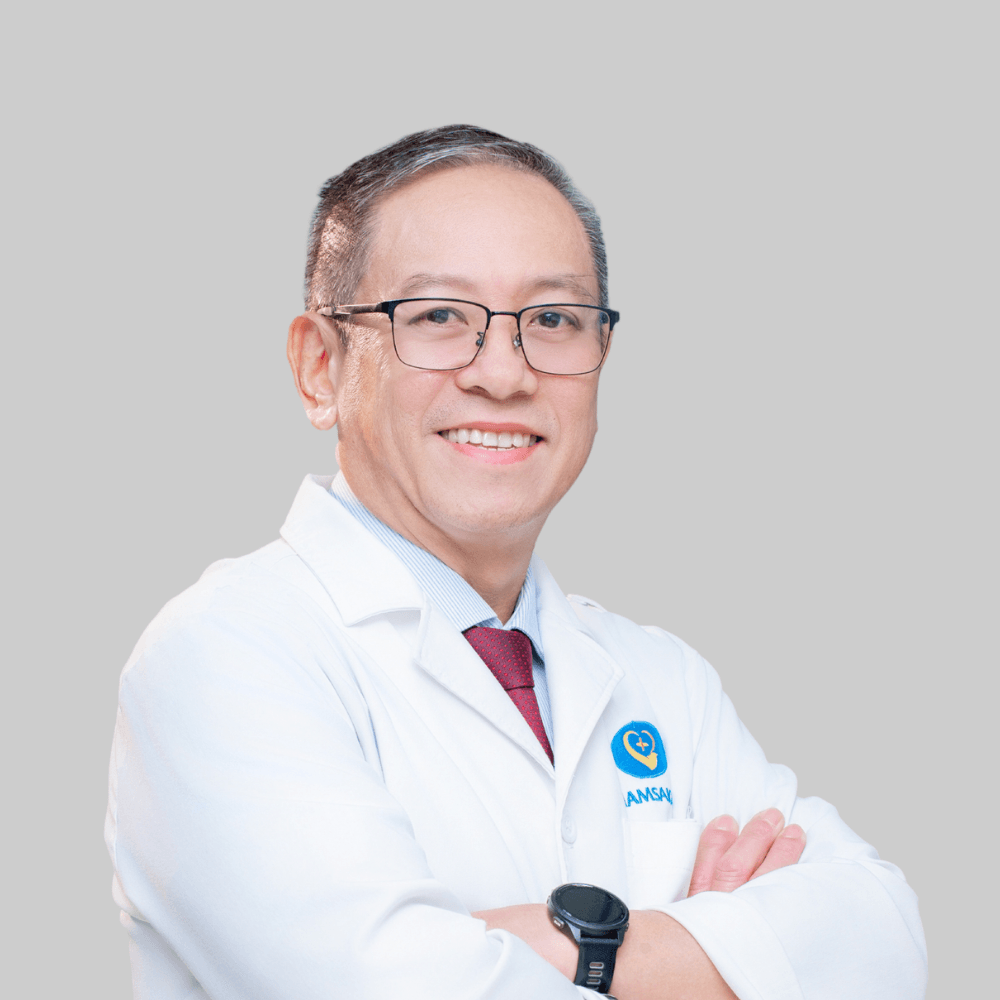
Specialist Level II Doctor Vo Van Man
MD, Specialist Level II Vo Van Man is the Head of Department of Orthopedics - Spine at Nam Saigon International General Hospital, with more than 34 years of experience in diagnosing, treating, and performing surgery for musculoskeletal disorders. The physician is proficient in numerous advanced orthopedic and arthroscopic techniques, having previously served as Head of Department of Orthopedics - Spine at Saigon ITO Hospital and worked for many years at Cho Ray Hospital and Trung Vuong Hospital.
Position: Head of Department of Orthopedics - Spine, Nam Saigon General Hospital
Languages: Vietnamese, English
So 88, Duong so 8, Khu dan cu Trung Son, Binh Hung Commune, Ho Chi Minh City, Ho Chi Minh City
Mon, Wed: 07:00-12:00, 13:30-17:00
300.000đ
About Specialist Level II Doctor Vo Van Man
MD, Specialist Level II Vo Van Man is a leading expert in the field of Orthopedics - Spine with more than 34 years of experience in diagnosing, treating, and performing surgery for musculoskeletal disorders. The physician has worked for many years at reputable top-tier hospitals such as Cho Ray Hospital and Trung Vuong Hospital, and previously held the position of Head of Department of Orthopedics - Spine at Saigon ITO Hospital.
Currently, MD, Specialist Level II Vo Van Man holds the position of Head of Department of Orthopedics - Spine at Nam Saigon International General Hospital. With extensive practical experience and wholehearted dedication to patients, the physician is always a solid professional pillar, bringing comprehensive motor rehabilitation opportunities to thousands of patients.
Conditions examined and treated by the physician
Possessing more than 34 years of clinical experience and mastering many modern medical technologies, MD, Specialist Level II Vo Van Man has superior strengths in diagnosing, surgically treating, and managing injuries belonging to the musculoskeletal system:
- Examination, diagnosis, and surgical treatment of bone and joint injuries such as fractures, dislocations, and ligament and soft tissue injuries caused by accidents.
- Application of advanced arthroscopic techniques to diagnose and treat ligament disorders, meniscal tears, and synovitis in the knee and shoulder joints.
- Performing advanced orthopedic techniques and artificial joint replacement surgery (total knee replacement, total hip replacement) for patients with severe osteoarthritis.
- Examination and development of comprehensive medical treatment regimens for chronic musculoskeletal disorders such as osteoarthritis, rheumatoid arthritis, gout, and osteoporosis.
- Counseling and developing physical therapy and rehabilitation pathways after injury or postoperative recovery to help patients quickly reintegrate into daily life.
Guide to scheduling appointments and the examination process with MD, Specialist Level II Vo Van Man
- Step 1: Make an appointment via Bcare by calling the hotline or filling out the appointment information on the system to obtain a priority number, thereby proactively managing examination time and minimizing waiting times.
- Step 2: Arrive to verify the scheduled appointment at the reception desk of Nam Saigon International General Hospital so that healthcare professionals can assist with checking information, measuring basic vital signs, and completing initial medical record procedures.
- Step 3: Enter the Specialty Clinic for MD, Specialist Level II Vo Van Man to directly perform a clinical examination, assess the range of motion of the joints, evaluate tender points, and ask detailed questions about the mechanism of injury or disease progression.
- Step 4: Move to functional rooms to undergo paraclinical tests as per the physician's orders, such as radiography, Magnetic Resonance Imaging (MRI), computed tomography (CT scan), or specialized blood tests.
- Step 5: Return to the original clinic for the physician to analyze radiologic outcomes, provide a definitive diagnosis, thoroughly explain the health status, and advise on the optimal medical treatment regimen or surgical indication.
Notes before the visit
- Patients need to bring all previous X-ray films, MRI scans, CT scans, and prescriptions related to musculoskeletal disorders so the physician can cross-reference the data.
- In cases where the patient intends to have or is indicated for interventional surgery on the same day, they must strictly remain nil by mouth for 6 to 8 hours prior.
- Choose loose, comfortable clothing (especially wide pants) to facilitate the physician's exposure of the injured area and performance of joint movement assessments.
- Patients experiencing severe pain, difficulty ambulating, or limited range of motion due to bone and joint injuries should be accompanied by a relative to support them throughout the movement process.
Frequently Asked Questions
What are the superior benefits of advanced arthroscopic techniques for patients with ligament and meniscal injuries?
Arthroscopy is a minimally invasive technique using a very small-diameter scope equipped with a camera inserted into the joint cavity through a minimal skin incision. This technique allows the physician to visually observe the entire injury clearly to perform meniscus repair or ligament reconstruction with the highest precision. Compared to traditional open surgery, arthroscopy helps minimize pain, maximally limit infection risk, preserve surrounding healthy tissues, and enable patients to rapidly recover joint motor function.
When are patients with hip osteoarthritis or knee osteoarthritis indicated for artificial joint replacement surgery?
Artificial joint replacement surgery is typically indicated for cases of osteoarthritis in the serious phase, when articular cartilage has been completely eroded and medical treatments or physical therapy no longer provide effective pain control. Patients experiencing prolonged severe pain even at rest, joint deformation, leg axis deviation, or significant difficulty in daily activities such as walking or climbing stairs will be advised by the physician to undergo joint replacement for quality-of-life improvement.
What should patients note regarding the rehabilitation process after undergoing orthopedic bone and joint surgeries?
Post-orthopedic surgery rehabilitation is a determinant factor accounting for 50% of the success of the operation, helping prevent complications such as joint stiffness and muscle atrophy, and restoring range of motion. Patients must absolutely adhere to the schedule and exercises according to the instructions of the physician and physical therapist, avoiding voluntary overexertion or skipping sessions. During home exercises, if abnormal signs appear such as progressively increasing joint swelling, heat upon palpation, shooting pain, or fluid discharge from the surgical wound, the patient needs to come to the hospital for an immediate follow-up visit.
Professional strengths
Workplace
- •Nam Saigon General Hospital
Experience
- •- 1996-2001: Attending physician at Cho Ray Hospital
- •- 2001-2003: Head of Department of Orthopedics - Spine, Saigon ITO Hospital
- •- 2003-2005: Attending physician, Emergency Center at Trung Vuong Hospital
- •- 2005-2020: Head of Department of Orthopedics - Spine, Saigon ITO Hospital
- •- 8/2020-present: Head of Department of Orthopedics - Spine, Nam Saigon International General Hospital
Education & training
- •- 1986-1992: University of Medicine - Tay Nguyen University
- •- 1999: University of Medicine and Pharmacy at Ho Chi Minh City
- •- 1999-2001: MD, Specialist Level I in Orthopedics - Spine - University of Medicine and Pharmacy at Ho Chi Minh City
- •- 2013-2015: MD, Specialist Level II in Orthopedics - Spine - Pham Ngoc Thach University of Medicine